
Why follow-up matters in lead generation: 60% higher ROI

Ignoring follow-up costs agencies over 60% of potential sales, yet most marketers underestimate its power. Effective follow-up transforms lukewarm leads into paying clients by building trust through strategic, multi-touch engagement. This guide reveals proven timing strategies, debunks common myths, and shows how AI-powered automation scales personalized outreach to maximize your conversion rates and ROI.
Table of Contents
- Why Follow-Up Works: Psychological And Sales Mechanisms
- Optimal Timing And Frequency For Effective Follow-Up
- Common Misconceptions About Lead Follow-Up
- Technological Solutions And Automation For Scaling Follow-Up
- Practical Frameworks For Implementing Follow-Up Campaigns
- Conclusion: Turning Follow-Up Into Your Competitive Advantage
Key takeaways
| Point | Details |
|---|---|
| Conversion impact | Effective follow-up increases conversion rates by over 20% through strategic persistence. |
| Multi-touch strategy | Combining email, WhatsApp, and phone raises response rates by 40% compared to single-channel outreach. |
| Common pitfalls | Myths about annoying leads prevent necessary engagement touches that actually improve brand perception. |
| Automation advantage | AI-driven tools enable personalized, scalable follow-up that boosts pipeline velocity by 30%. |
| Implementation framework | Structured 5-7 touch sequences over 2-3 weeks maximize engagement without causing lead fatigue. |
Why follow-up works: psychological and sales mechanisms
Follow-up succeeds because it leverages fundamental human psychology and decision-making patterns. Multiple touchpoints create familiarity, triggering the mere-exposure effect where repeated contact breeds trust and preference. When you reach out consistently, prospects recognize your brand and feel more comfortable engaging with your services.
Persistence overcomes initial hesitation that kills most sales opportunities. Leads often ignore first contact not from disinterest but from poor timing or information overload. Your second, third, or fifth message might arrive exactly when they're ready to act. Personalized follow-up increases brand perception positivity by over 50%, transforming cold prospects into warm conversations.
Psychological triggers embedded in follow-up sequences drive action:
- Urgency signals that opportunities won't wait forever
- Social proof showing others benefit from your solutions
- Recognition refresh reminding prospects why they showed interest initially
- Value reinforcement demonstrating ongoing commitment to solving their problems
Relationship building separates effective follow-up from pushy sales tactics. Each touchpoint should offer genuine value, whether educational content, personalized insights, or solutions to specific pain points. This consultative approach positions you as a trusted advisor rather than a transactional vendor.
The audit-first approach to pitching redesigns demonstrates how value-driven follow-up creates natural sales momentum. When you lead with helpful analysis and actionable recommendations, prospects engage willingly because you've already proven your expertise and commitment to their success.
"The fortune is in the follow-up. Most sales happen after the fifth contact, yet most salespeople give up after the second attempt."
Consistent engagement keeps you top of mind during the prospect's evaluation period. Decision cycles for professional services often span weeks or months, meaning your timing matters less than your persistence throughout their journey. Strategic follow-up ensures you're present at the exact moment they're ready to commit.
Optimal timing and frequency for effective follow-up
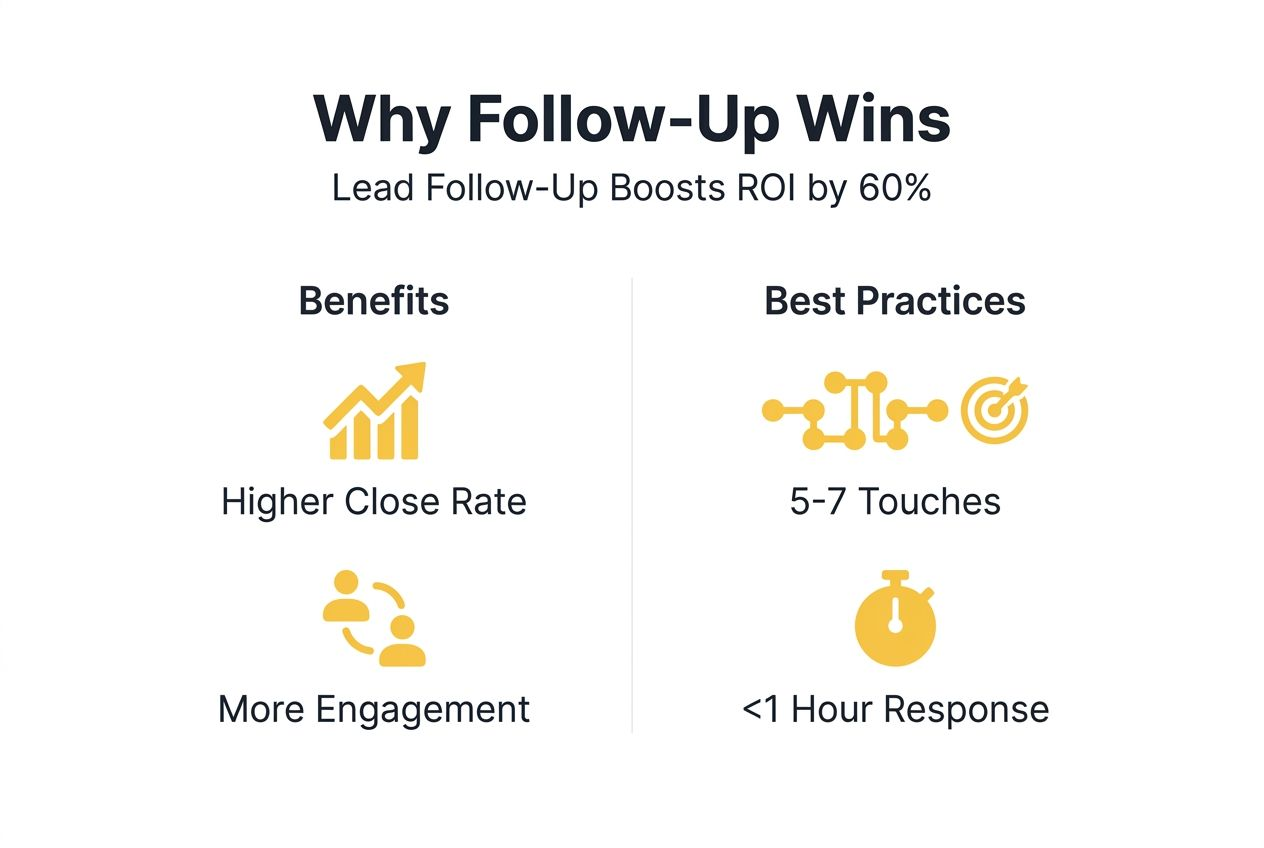
Speed determines success in lead response. Contacting leads within one hour increases conversion chances sevenfold compared to waiting even two hours. This window captures peak interest when prospects actively seek solutions and compare options. Delayed response signals low priority and allows competitors to capture attention first.

An optimal follow-up cadence balances persistence with respect for prospect time. Research shows 5-7 touches over 2-3 weeks maximizes engagement without triggering annoyance. This timeline aligns with typical B2B decision cycles while maintaining consistent presence throughout the evaluation process.
| Touch Point | Timing | Channel | Purpose |
|---|---|---|---|
| Touch 1 | Within 1 hour | Email + WhatsApp | Immediate acknowledgment and value offer |
| Touch 2 | Day 2 | Phone call | Personal connection and qualification |
| Touch 3 | Day 4 | Educational content addressing pain points | |
| Touch 4 | Day 7 | Quick check-in with case study | |
| Touch 5 | Day 11 | Testimonial and limited-time offer | |
| Touch 6 | Day 16 | Phone call | Direct conversation and objection handling |
| Touch 7 | Day 21 | Final value summary and clear CTA |
Multi-channel outreach amplifies response rates dramatically. Multi-channel follow-up increases response rates by 40% compared to email-only campaigns. Prospects have channel preferences, and reaching them where they're most active improves engagement odds. Combining email, WhatsApp, and phone calls ensures you connect through their preferred communication method.
Key timing principles to maximize conversions:
- Strike while interest peaks with sub-hour first responses
- Space touches strategically to avoid fatigue but maintain presence
- Vary channels to respect preferences and increase visibility
- Monitor engagement signals to adjust frequency dynamically
- Front-load value in early touches to earn permission for continued contact
Pro Tip
Use automating agency lead gen strategies to maintain rapid response times without manual monitoring. Automation ensures no lead waits while you sleep or handle client work, capturing opportunities competitors miss through delayed follow-up.
Lead engagement signals should guide your follow-up intensity. Email opens, link clicks, and content downloads indicate active interest warranting more frequent contact. Radio silence suggests backing off temporarily while maintaining presence through lower-touch educational content. Smart Thyonix AI lead generation and website builder platforms track these signals automatically, adjusting cadence based on prospect behavior rather than rigid schedules.
Avoid over-contacting by watching for disengagement patterns. If three consecutive touches generate zero response, shift to monthly nurture sequences rather than weekly pressure. This respects prospect autonomy while keeping you visible for future needs. Best practices from cross-channel lead nurturing emphasize quality over quantity in every interaction.
Common misconceptions about lead follow-up
Myth: Follow-up annoys leads and damages brand perception. Reality shows the opposite. Properly timed, value-driven follow-up actually improves how prospects view your professionalism and commitment. The annoyance factor appears only when messages lack relevance or provide zero value beyond asking for the sale.
Myth: One or two follow-ups suffice for interested prospects. Data proves persistence wins. Most conversions happen after the fifth touchpoint, yet 44% of salespeople quit after just one follow-up attempt. You're competing against their busy schedules and competing priorities, not their interest level.
Assuming leads prefer email-only contact ignores multi-channel effectiveness realities. Younger decision-makers often favor WhatsApp or text for quick exchanges, while senior executives may prefer phone calls. Limiting yourself to email cuts response rates by over half compared to strategic multi-channel outreach.
Common follow-up fears that limit success:
- Worrying about seeming pushy prevents necessary persistence
- Assuming silence equals disinterest rather than poor timing
- Believing automated outreach can't feel personal or valuable
- Thinking follow-up wastes time better spent finding new leads
- Fearing rejection more than missing conversion opportunities
Technological solutions and automation for scaling follow-up
Scaling follow-up without losing personalization requires the right technology stack. CRM systems centralize lead data, ensuring every interaction history informs future outreach. This prevents embarrassing duplicate messages and ensures continuity across team members.
Automation platforms handle repetitive tasks like initial acknowledgments and nurture sequences, freeing human agents for high-value conversations. AI-driven tools now personalize content at scale, analyzing prospect data to tailor message tone and timing for maximum impact.
Practical frameworks for implementing follow-up campaigns
Effective campaigns start with clear segmentation. Group leads by industry, source, or interest level to ensure message relevance. Develop templates that allow for modular customization—swapping in specific pain points or industry news while keeping the core value proposition consistent.
Testing and optimization ensure continuous improvement. A/B test subject lines, send times, and call-to-action phrasing. Analyze metrics like open rates and reply rates to refine your approach. Remember, a framework is a starting point; adapt it based on real-world performance data.
Conclusion: Turning Follow-Up Into Your Competitive Advantage
In a crowded market, persistence is a differentiator. While competitors give up after one email, your strategic follow-up builds trust and keeps you top-of-mind. By combining psychological insights with optimal timing and automation, you turn lost leads into loyal clients.
Ready to implement these strategies?
Start finding high-quality leads for your web design business today with Thyonix's AI-powered tools.